There aren’t many moments from my undergraduate history classes at the Australian National University that stand out in my memory. I hope this is because everything I learned has become second nature, rather than because I’ve forgotten it all! But one thing I do remember as a true lightbulb moment is a lecture by feminist historian Jill Julius Matthews. She introduced me to the idea of gender as a social construction, distinct from biological sex, and to the concept that both sex and gender could not be reduced to simple binary categories. It’s true that gender as a social construction is different from, though connected to, gender as a sense of personal identity and the related idea that a person can identify with a gender that differs from the sex they were born into. But the key point is that gender is every bit as real in people’s lives as biological sex.
I’ve been thinking about that undergraduate lecture recently, since a Member’s Bill from New Zealand First MP Jenny Marcroft, the Legislation (Definitions of Woman and Man) Amendment Bill, has been referred to a select committee. Submissions on the Bill are due by 2 July. The Bill would amend the Legislation Act 2019 to provide that in any legislation, ‘regardless of gender identity’, ‘woman’ and ‘female’ refer to a ‘human biological female’ and ‘man’ and ‘male’ refer to a ‘human biological male’.
There are many reasons to oppose this Bill, not least that its sponsor clearly hasn’t even thought through its legal implications. (Has anyone from New Zealand First searched the Legislation website looking to see where the relevant terms are used, and whether the proposed definitions even make sense in context? I doubt it.) But there are a couple of points I can make from my perspective as a historian.
First, throughout history and across cultures, there have been people who have not fitted neatly into binary concepts of sex and gender. And while those people probably also don’t fit neatly into modern categories (because our ideas of sex and gender change over time), their existence is clear evidence that gender nonconformity is not the product of a modern ‘gender ideology’.
Second, it has historically been conservative and reactionary political movements that have sought most enthusiastically to establish clear sex boundaries and enforce these in law. From fundamentalist religious movements to fascists, the authoritarian right has demonised people who challenge gender norms, and continues to do so today. It’s hard to understand how anyone who supports a liberal or liberatory politics could want to entrench a rigid sex binary in law. It might be more useful to ask whether all of the existing legal references to ‘male/man’ and ‘female/woman’ continue to serve a purpose than to seek to define these terms.
Speaking of pointless legislation that may nonetheless have negative impacts, has there ever been a proposed law as stupid as the English Language Bill? This Bill would declare English to be an official language of New Zealand – even though English is already a de facto official language, one that can be used in all official contexts in Aotearoa New Zealand. For more thoughts on this very silly Bill you can see my submission (made under my non-historian name).
In another month, the United States will celebrate the 250th anniversary of the adoption of the US Declaration of Independence. Unfortunately, this anniversary couldn’t come at a worse time for the country, and for efforts to confront its past honestly. As Mother Jones magazine explored recently, President Trump has engaged in a war on history and historical institutions. Trump is determined to impose a simplistically patriotic narrative, one which celebrates the ‘greatness’ of the US and downplays uncomfortable stories like those of slavery and indigenous dispossession. This seems to be the narrative that will dominate official commemorations of the 250th, although no doubt there will be efforts at the local level to tell a different story. It’s not as though the bicentennial in 1976, or earlier half-century anniversaries, were free of controversy, however. As historian Jill Lepore discusses in the New Yorker, the bicentennial came after Watergate and the protest movements of the 1960s and early 1970s, and some of the sense of national malaise and uncertainty was evident in discussions of that anniversary. Nonetheless, a plethora of local activities took place, often with Federal funding, including ‘a tremendous investment in American history, civic education, and civil society. … Ironically, many of these initiatives are now being dismantled due to both a lack of funding and ideological pressure.’
Sticking with the US, I mentioned previously the podcast Rebel Spirit, in which Akilah Hughes sought to have the sports teams of the high school she attended in Kentucky renamed from the ‘Rebels’, a name that references the pro-slavery Confederacy in the US Civil War. Rebel Spirit is now partway through its second season, and this one is even more relevant to my interests, focusing as it does on monuments. In this season, Hughes once again uses a specific case study as a window into larger issues, by trying to find a replacement for the statue of Confederate President Jefferson Davis that was removed from the Kentucky State House a few years ago. Well worth a listen (although the number of ads in each episode is quite annoying!)
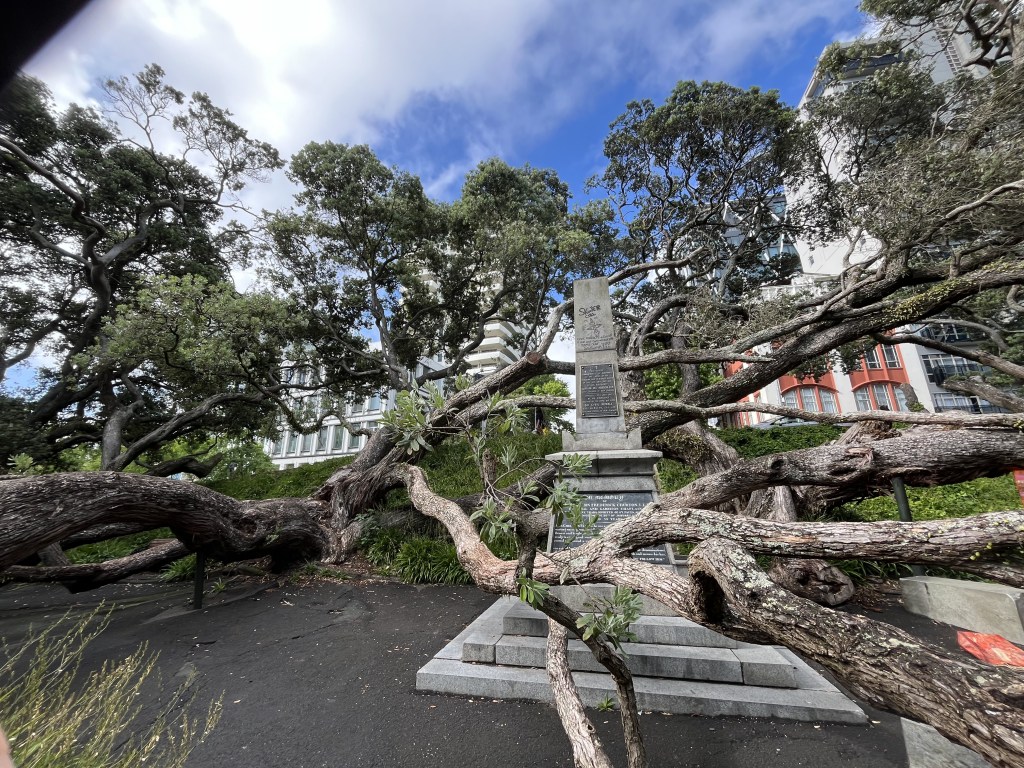
And on the subject of monuments, I was alerted by Charlotte Macdonald’s wonderful book Garrison World: Redcoat Soldiers in New Zealand and across the British Empire (recent and well-deserved winner of the Ernest Scott Prize for Australian and New Zealand history) to a memorial I hadn’t previously known about. The memorial to Rev John Frederick Churton, colonial chaplain and first vicar of St Paul’s Anglican church, sits in Emily Place Reserve in central Auckland, and I paid it a visit on a trip to Auckland last year.
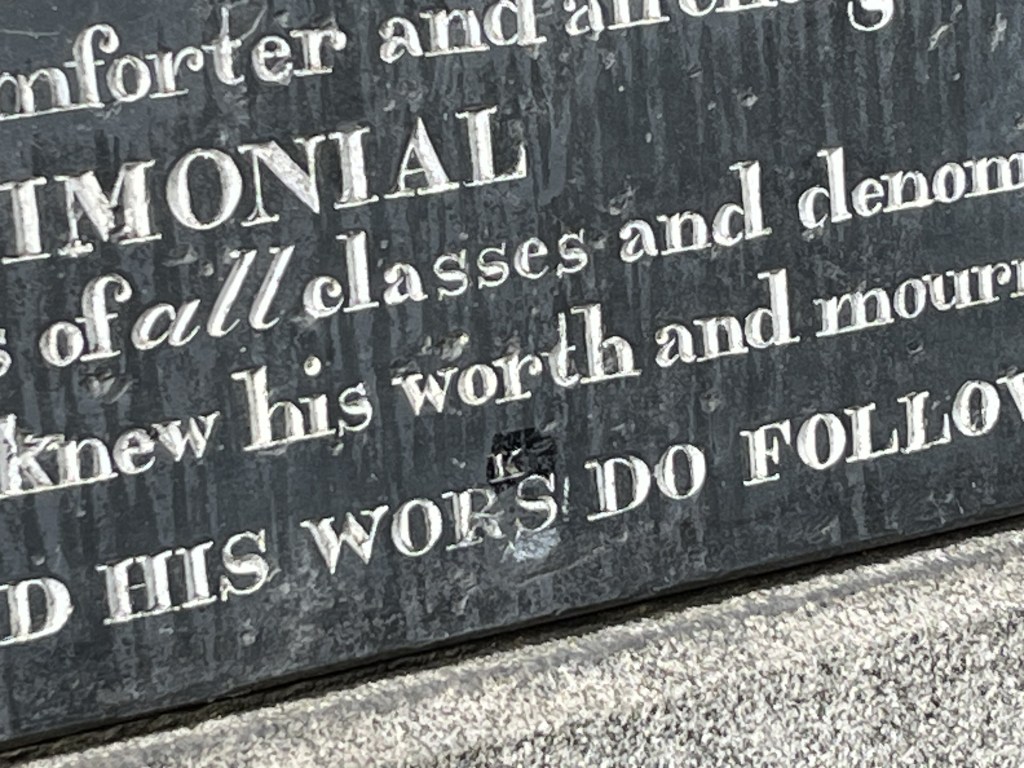
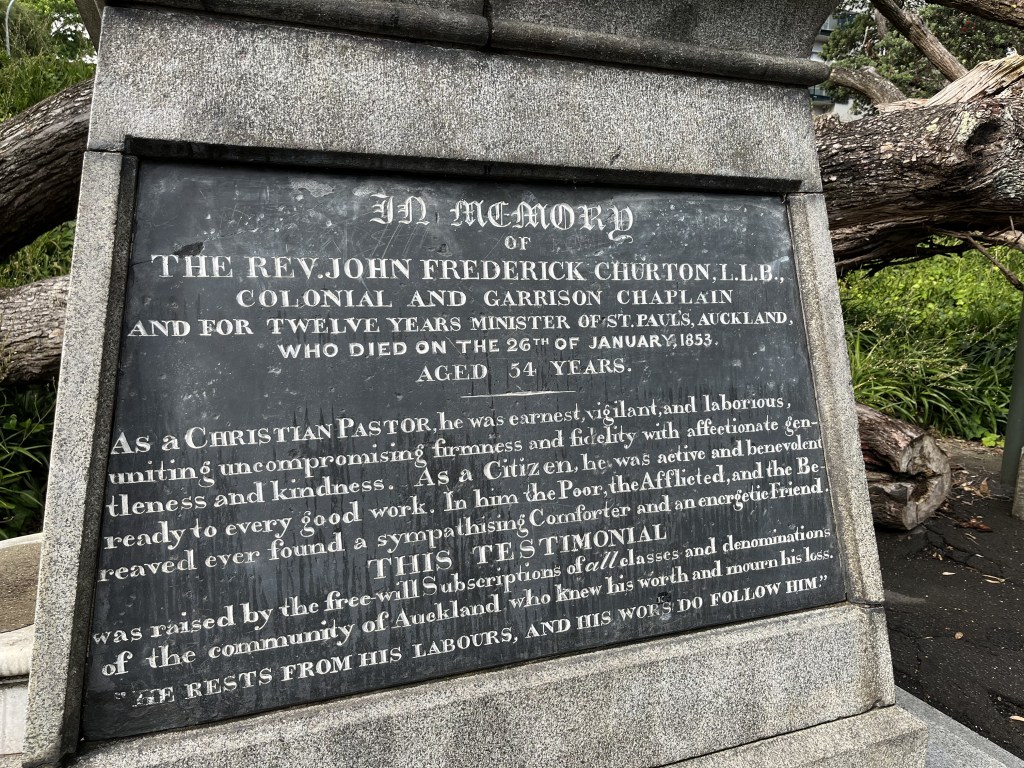
The main plaque celebrates Churton for his ‘earnest, vigilant, and laborious’ work: ‘In him the Poor, the Afflicted, and the Bereaved ever found a sympathising Comforter and an energetic Friend.’ The stone mason slipped up, however, and at the bottom the plaque states ‘HIS WORKS DO FOLLOW HIM’, with a smaller letter ‘k’ inserted in the word ‘works’.
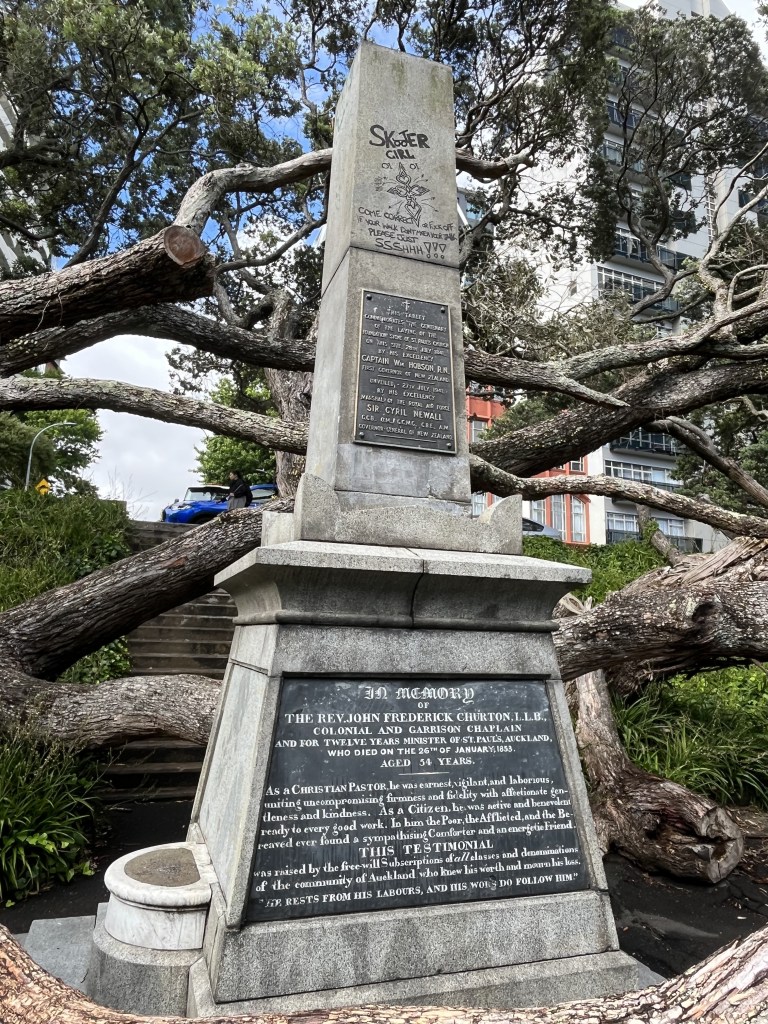
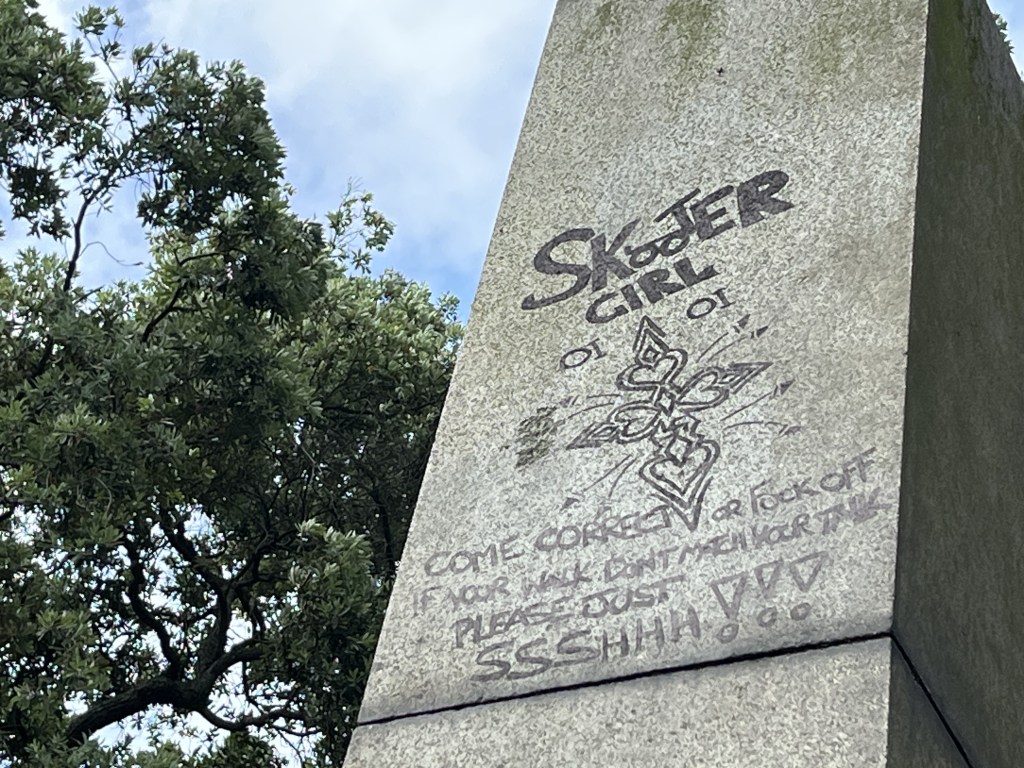
Today, the memorial is completely enclosed within a giant pōhutukawa, as though nature is trying to reclaim the space, and on the day I visited the memorial had been relatively freshly graffitied, with the words: ‘Skooter Girl Oi Oi. Come correct or f— off if your walk don’t match your talk please just ssshhh!!!’ Which seems oddly apt, since much of the debate about memorials relates to whether the ‘walk’ of those we commemorate in public places really matches the way memorials ‘talk’ about them.
Finally, a recommendation. I don’t read many graphic novels, but I recently enjoyed Dear Historian by Joff Winterhart. It tells the story of Margaret, a historian in her 70s, who is approached by 30-something TV producer Lucy to be part of a popular history programme. It’s a gentle story about the relationship between the two main characters and their growing affection and respect for each other. Despite the title, it’s not primarily about history, but it does include an entertainingly horrifying portrayal of Lucy’s boss, an egotistical popular history presenter called Allan Hands. The book has lovely illustrations in black and white, and even comes with its own music playlist, which I’m looking forward to listening to!
 PastWord