Prime Minister Helen Clark launches the Earth Sea & Sky theme of Te Ara at the Embassy Theatre, Wellington, 12 June 2006. Nathan, Simon, 1943-: Photographs of the Kermadec Islands, Antarctica, Inangahua, Mount Ngauruhoe, and various New Zealand locations. Ref: PADL-002034. Alexander Turnbull Library, Wellington, New Zealand, /records/45620447.
My friend and fellow historian Kate Hunter and I have just had an opinion piece published on Newsroom, looking at the attacks on the historical profession in Aotearoa New Zealand over the past few years. The article is a response to the gutting of the history team at Manatū Taonga, the Ministry for Culture and Heritage, the team that has produced such outstanding resources as Te Ara – the Encyclopedia of New Zealand and the Dictionary of New Zealand Biography. The cuts at Manatū Taonga come on top of the continuing devastation of university history departments, cuts to staffing and services at Archives New Zealand, and the ending of funding for the humanities and social sciences through the Marsden Fund. And that’s without even considering further threats looming in future. What will the promised ‘rebalancing’ of the history curriculum in schools look like? What are the implications of the Government’s pressure on local councils to focus on ‘basics’ for local funding of museums, archives, libraries, and heritage protection and interpretation?
Historians are not taking these attacks lying down. A number of associations of historians have joined together to issue a very strongly-worded statement on the restructuring at Manatū Taonga. Historian Vincent O’Malley has written a couple of posts on what he’s called the ‘war on history’, and was also interviewed by Stuff. Former Chief Historian Jock Phillips has also spoken out strongly in a couple of interviews on Radio New Zealand.
Will the politicians who are responsible for these funding decisions listen to the chorus of outrage? It’s hard to be optimistic. And yet a lot of people care deeply about Aotearoa New Zealand’s history, and greatly value resources such as Te Ara. It’s notable that the New Zealand Society of Genealogists was among the organisations that signed the letter of protest, and genealogy is a hugely popular pastime. Politicians need to know that people care about our past, and want it to have a future. If you’re one of those people, please consider writing to your local MP or to the Minister for Arts, Culture and Heritage or other Ministers.
In happier news, Bruce Connew’s wonderful photographic exhibition ‘A Vocabulary’ is about to open at the National Library in Wellington. I wrote about the exhibition here. At the time I’d only been able to view the book based on the exhibition, but since then, I’ve had the opportunity to see the exhibition at Toi Mahara Gallery in Waikanae. I can confirm that it’s well worth seeing in person. The photography of the colonial memorials is stunning, and the impact of seeing the photographs together is even greater than seeing them on the page. This work is so clever in the way it subverts heroic colonial narratives by picking out particular words in the inscriptions. If you’re able to, please do go and see it, and you may also like to get along to the artist talk that Bruce is giving on Saturday 16 August.
Beggs Musical Instruments (1975). K E Niven and Co: Commercial negatives. Ref: 1/2-228106-F. Alexander Turnbull Library, Wellington, New Zealand. /records/23160468
I have a good excuse for not having written a blog post for some time – I’ve been recovering from a serious illness. I hope to get back to writing new material before too long. But in the meantime, and in celebration of New Zealand Music Month, here is a piece I originally wrote for the now-defunct blog of the online encyclopedia of New Zealand, Te Ara. The blog was a way of promoting the wide variety of information available on Te Ara, so most of the links in the piece below are to stories or images from that encyclopedia. Ngā mihi o Te Marama Puoro o Aotearoa ki a koutou!
Following the success of Neil MacGregor’s radio series and book, A History of the World in 100 Objects, it seems as though everyone is writing history through objects – and who am I to buck a popular trend? So, here are some key themes in the history of Aotearoa New Zealand, traced through musical instruments.
Pūtōrino – the natural environment. The pūtōrino is unique to New Zealand, and has both a flute-like ‘female’ voice and a trumpet-like ‘male’ voice, depending on how it is played. The story goes that Hine Raukatauri, daughter of Tāne, loved her pūtōrino so much that she decided to live inside it by turning herself into a case moth. The case moth’s long, tapering cocoon resembles, and may have inspired, the shape of the pūtōrino. Not only were taonga puoro, Māori musical instruments, made from natural materials but they were also inspired by the shapes and sounds of the natural world which Māori observed so closely.
Human voice – community. The power of the human voice unites us as human beings – almost everyone can sing or chant, after their own fashion. From the karanga welcoming visitors to the marae; to traditional waiata telling of love, loss or ancestral deeds; more recent Māori songs of remembrance, celebration and political protest; folk songs recording the pleasures and pains of everyday life; wartime songs relieving the tension and boredom of military life; national anthems sung together on important occasions; the vocal virtuosity of beatboxing, an integral part of hip hop culture; or the joy and power of singing together in choirs – singing reminds us that we belong to communities. Singing can be a means of self-expression too, but even then we can take shared pleasure and pride in the talent of individual singers, from Kiri Te Kanawa to Lorde.
Jew’s harp – culture contact. The jew’s harp is a small instrument played by placing one end in the mouth and plucking a reed attached to the frame, producing a twanging sound. Māori had a similar instrument, the rōria. Because they are so portable, jew’s harps were brought to New Zealand from the earliest days of Pākehā settlement, and were used as part of the payment for the New Zealand Company’s ‘purchases’ of vast areas of Māori land (in Whanganui, for example). Like so many other new technologies and ideas, they were taken up enthusiastically by Māori, replacing traditional instruments.
Bugle – war. Māori had a number of instruments – such as the pūtātara and pūkāea (shell trumpet and wooden trumpet) – whose sound carried over long distances and which were therefore used for signalling in time of war. The bugle was used in a similar way by Pākehā. During the New Zealand Wars, the bugle featured in such stories as that of Bugler Allen, killed at Boulcott’s Farm in the Hutt Valley, and Te Kooti’s lieutenant Peka Makarini, who used misleading bugle calls to confuse colonial troops. Bugles were also used in the First World War and later conflicts, and now play an important role in commemoration of war during the Last Post ceremony.
Piano – domesticity. For Pākehā, the importation (and, later, the domestic production) of pianos helped to create a sense of home. A piano in the home was both an important part of the décor and a focus for entertainment, with family and friends gathering around the piano to sing and dance. For women, playing the piano could sometimes be a respite (however brief) from household chores. There was a strong class dimension to all of this, of course – not everyone could afford a piano – and in time, the more affordable, but arguably less participatory, radio took the place of the piano in living rooms.
Drum – diversity. Drums are often associated with uniformity – keeping people in time and in step. Yet they can also represent the diversity of cultures and beliefs in modern New Zealand. Traditionally, Māori had a range of rhythmic instruments, but unlike their Polynesian cousins they did not use drums – their closest equivalent was the pahū, a wooden gong. During the colonial period, drums were part of the equipment of war, but were also used by Māori who were dedicated to peace. Drums are an important part of New Zealand’s diverse marching and parading traditions, whether those parades are political, religious, military or carnivalesque in nature. More recently, migration and cultural exchange have brought a much wider range of drums and drumming traditions to New Zealand, including those of the Pacific, Africa and Asia.
Guitar – fun. As in much of the rest of the world, guitars are central to popular music of all sorts in New Zealand,including folk, country and blues, pop and contemporary Māori music. Guitars also give New Zealand popular music some of its distinctive inflections, from the classic ‘jinka jink’ Māori strum to the jangling or droning guitars of the Dunedin sound and the Pacific flavour of New Zealand reggae (heavier on the guitar and lighter on the bass than the Jamaican original). Above all, the guitar has become New Zealand’s good-time, party instrument. Nothing symbolises this better than the enduring popularity in New Zealand of a relatively obscure Engelbert Humperdinck B-side, ‘Ten Guitars’. The song has become a cultural reference point for everyone from bored troops in Vietnam to sculptors. So, all together now: ‘I have a band of men and all they do is play for me…’
I haven’t had time lately to write longer posts for this blog. I will start writing longer pieces on specific topics again in future, but for now I’m going to try something different. From time to time, I’ll post short discussions of things I’m reading, listening to, watching, and so on, that relate to the themes of this blog. So here, just in time to provide some much-needed distraction from the US election, is the first such post.
Listening: I’ve been listening to the podcast Rebel Spirit from writer, comedian and podcaster Akilah Hughes. The show is about Hughes’s efforts to get her former high school in Kentucky to change the name of its sports teams from the Rebels (perhaps tongue-in-cheek, Hughes proposes changing the name to the Biscuits so that it references a more unifying aspect of Southern culture). As one of the few African-American students when she was at school, Hughes always felt unhappy with a name that so clearly referred to the Confederacy, and as an adult she decided to campaign for change. In 2017 the school finally did away with its mascot, a Confederate soldier called ‘Mr Rebel’, but the Rebel team name has remained.
Over the course of the series, Hughes explores the importance and meaning of team mascots, the history of ‘rebel’ team names in the US, how other teams have changed their mascots, controversies over other mascots (particularly those that use derogatory imagery of Native Americans), and much more. She busts some myths (notably the ridiculous and easily disprovable claim that the team name was adopted due to the popularity of the James Dean movie ‘Rebel Without a Cause’) and comes up against a seemingly immovable school bureaucracy, but also finds local supporters and draws inspiration from other schools that have made similar changes.
I’ve found the series (which has one episode still to run, at least for now) entertaining and insightful about issues of symbolism, representation and confronting difficult histories.
Reading: I recently finished reading Zadie Smith’s latest novel, The Fraud (2023), which I found enjoyable and ultimately quite moving. I was prompted to read it after listening to this interesting interview with Smith by New York Times columnist Ezra Klein. The novel is billed as being about the 1870s Tichborne case, in which Arthur Orton, a London-born butcher from Wagga Wagga in Australia, claimed to be Sir Roger Tichborne, the heir to an English noble family. Despite looking nothing like Sir Roger and having apparently forgotten Sir Roger’s fluent French, Orton attracted a loyal following, particularly among working class Britons. Zadie Smith herself has talked about parallels with the popularity of Donald Trump (dammit, how did he find his way into this post?), but it’s also about much more.
A central theme of the book is our capacity to delude ourselves, to believe what we want to believe and to look away from inconvenient truths, as well as the difficulty of understanding others or even ourselves. It shows how even the most perceptive person (like the central character, Mrs Touchet) can have blind spots, while those who might be considered most delusional (such as a staunch supporter of the Tichborne claimant, or an enslaved Jamaican woman who has wild prophetic visions) may see some truths more clearly than those who pride themselves on their rationality.
The book is also centrally concerned with slavery and empire, and how developments in Britain are intertwined with those in Britain’s colonies. After listening to the life story of Andrew Bogle, a formerly enslaved man from Jamaica who became a servant to the Tichborne family in England, Mrs Touchet (a white Scottish woman) has a revelation: despite her longstanding commitment to the Abolitionist cause, she had never previously understood that the stories of Britain and Jamaica were inseparable:
The exotic island of her conception was not some utterly different and unimaginable world. It was neither far away nor long ago. Indeed, it seemed to her now that the two islands were, in reality, two sides of the same problem, profoundly intertwined, and that this was a truth that did not have to be sought out or hunted down, it was not hidden behind a veil or screen or any kind of door. It was and had always been everywhere, like weather.
The interconnections between Britain and empire, and the ‘everywhere-ness’ of empire in Britain, are the focus of another book I’ve been reading: Corinne Fowler’s Our Island Stories: Country Walks through Colonial Britain (2024). Fowler is a historian who has been writing for some time about the connections between the British countryside and empire. She was involved in a project initiated by the National Trust, the UK heritage body, to examine and tell stories of the ways in which National Trust properties were implicated in slavery and colonialism. This led to a vitriolic campaign against her and the National Trust from right wing pundits and politicians, who accused the project of a ‘woke’ rewriting of history. To its credit, the National Trust didn’t back down. (Those attacking Fowler were largely the same people who are quick to cry ‘cancel culture’ when the work of writers such as the imperial apologist Nigel Biggar, currently touring New Zealand under the aegis of the ‘Free Speech Union’, is criticised. It’s also worth noting that Fowler is white, and that non-white British authors who write critically about empire for a popular audience – such as David Olusoga and Sathnam Sanghera – receive much more hateful abuse.)
Our Island Stories takes the form of a series of walks in the English, Welsh and Scottish countryside, each of which illustrates a different story of links between localities in Britain and different parts of the British Empire. On each walk, Fowler is accompanied by another walker whose ancestry connects them to empire and who has thought deeply about these imperial connections. Throughout the book, Fowler demonstrates not only how enmeshed the British countryside is with colonial expansion and exploitation, but also how stories of oppression within Britain are tied up with even greater oppression in Britain’s colonies: for example, how wealth from slavery fueled the enclosure of common lands by the landowning elite in England. Fowler comments that ‘if we know where, and how, to look, these local histories of colonialism are frequently hidden in plain sight.’ Or, as Zadie Smith puts it, they are ‘everywhere, like weather.’
Today’s post covers a number of topics, all loosely connected by the theme of history in public.
At the moment, much of my spare time that might otherwise be spent on researching or writing history is being taken up by my current role as co-president of the Professional Historians’ Association of New Zealand/Aotearoa (PHANZA). In that capacity, I prepared a PHANZA submission on the Fast-track Approvals Bill. As most people will know, the Bill (which is currently before Parliament’s Environment Committee) gives a small group of Ministers extraordinary powers to approve infrastructure and development projects, and prioritises development over all other considerations. While much of the focus on the Bill has rightly been on its implications for the natural environment, PHANZA’s submission highlights the potential impacts on historic heritage sites. A particular concern is the potential impact on sites of significance to Māori, and the submission notes the long history of economic and infrastructure development taking place at the expense of Māori.
Also of great concern at the moment are the changes currently taking place at Archives New Zealand and the National Library. Historians are very concerned at the recent announcement by Archives that it will be ending its digitisation programme. This important programme has made archival holdings much more accessible to people living outside the main centres where Archives has its reading rooms, and to those who otherwise find it difficult to visit Archives in person. Moreover, Archives reduced its reading room hours several years ago, a decision that was explained in part by a reprioritisation towards digitisation. More recently, a project to build an archival storage facility in Levin was cancelled, with the explanation that ‘digital technological advances had … reduce[d] the demand for physical storage’. Now it turns out that the much-heralded digitisation won’t be continuing either. Meanwhile, the National Library is also reducing its staff as part of the Government’s public sector cutbacks.
During the week, Public Service Association members organised a protest against the ending of the digitisation programme and related cuts. If you share these concerns, please write to the Minister of Internal Affairs (the Minister responsible for Archives New Zealand and the National Library) and contact your local Member of Parliament about the importance of properly funding our national archival and library institutions. And on a lighter note, digitisation not only makes important research material accessible for historians but also allows the wider public to read about quirky stories from our past, as this entertaining piece by Hera Lindsay Bird in the the Spinoff shows.
The relationship between historical research and public understanding is the subject of a fascinating recent piece in the Guardian by historian Vincent Brown. Brown, the author of Tacky’s Revolt: The Story of an Atlantic Slave War, describes his role in, and discomfort with, Jamaica’s public commemoration of Takyi or Tacky, a leader of resistance by enslaved people in 18th-century Jamaica. I strongly recommend the article, in which Brown describes his mixed feelings about the ways in which his work has been taken up by both the Jamaican state and some activists in their moves to commemorate Tacky. In particular, he discusses the oversimplification and selectivity that comes with commemoration, and the loss of complexity and nuance, while also recognising the importance of communities engaging with their history and the difference between the role of the historian and that of people engaged in the construction of public memory. Brown writes:
As a professional historian, I weigh documentary evidence and interpret the past with great confidence. I am less certain of my authority to make the past accountable to the needs of the present. …
Historians do not get to decide what to memorialise, or how, or where. The way societies choose to mark history depends on whose stories can command material support and whose sensitivities must be treated with care. … People fight over history not just to know the truth, but because stories about the past continue to shape the present. …
Likewise, monuments to past ordeals and triumphs – such as Admiral Nelson’s statue at Trafalgar Square in London, or a proposed tribute to the heroism of an African warrior – shape the present, and the future, in ways that are always uncertain. They could inspire future generations, or they might instead herald a chauvinism that impedes attempts to solve today’s problems. When a story that has been refused becomes the head cornerstone of state image-making, there is no guarantee of accommodation for all.
Nothing I’ve written is in the same league as Vincent Brown’s work, and my writing certainly hasn’t been influential in the way that his has. But having, in my own way, made tiny interventions in support of greater public recognition of the impact of the New Zealand Wars, I can recognise some of Brown’s ambivalence. Over the past decade, the public presence of the New Zealand Wars has grown enormously. This has undoubtedly been a good thing, but it also has its downsides. I worry that the public accounts of the New Zealand Wars focus too much on stories of battles, and too little on the impacts and aftermaths of the wars. I’m concerned, too, that we continue to focus so much on narratives of Great Men (and their shadow narratives of Great Villains), at the expense of the experience of ordinary combatants and civilians. And I wonder whether the focus on the wars is now starting to crowd out other, equally important stories from our colonial past.
Ultimately, though, I recognise that historians need to undertake their work with as much attention to accuracy and nuance as they can, while remaining humble about the extent to which they can shape either when or how the historical narrative enters the public sphere. I was reminded of this when someone circulated an article written by the New Zealand historian Ben Schrader, who died recently. Ben was a great historian of urban life and heritage advocate, and a very kind and supportive historical colleague. He wrote a piece in the PHANZA newsletter Phanzine in 2018 about his engagement with the history of the Lower Hutt suburb of Naenae, and with the present-day Naenae community. Ben concluded that ‘the public historian has an important role in informing the public, but then has no say over the moment the public decides that information is useful to them. I like that.’
And finally, I was delighted to see the Spinoff recognising, at number 29 on its Power List of ’50 New Zealanders You Need to Know’, the statue of the young Ernest Rutherford near Nelson. What the Spinoff rightly describes as ‘the terrifying statue of a four-year-old Ernest with the face of a grown man’ is the perfect illustration that you can never quite control or predict how the past will appear in the present.
A: The German Nazi regime, founded on a belief in the supremacy of the Aryan ‘race’ and ruled as a dictatorship by a single party and leader, which launched a war of aggression in Europe, embarked on a systematic campaign of extermination of Jews, and murdered political opponents, Roma and Sinti, homosexuals and disabled people.
B: The apartheid regime of South Africa, founded on a belief in the supremacy of the white ‘race’, which stole the land and resources of black Africans, exploited black labour, denied non-white people the vote and other political rights, and jailed, tortured and assassinated its political opponents.
C: The American South during the Jim Crow era, when laws based on a belief in the supremacy of the white ‘race’ denied African Americans voting and other political rights, African Americans were confined to substandard schools and housing and to the most menial and low-paid work, and the Ku Klux Klan and other armed groups regularly terrorised African American communities with lynchings and mob violence.
D: Political policies in contemporary Aotearoa New Zealand which aim (after decades of political processes which marginalised Māori) to give Māori a formal role in decision-making, to ensure that their interests and cultural perspectives are represented; or which facilitate the establishment by Māori of their own services, organisations and spaces where they can (if they choose) be themselves, govern themselves and help themselves in an environment underpinned by Māori cultural values and practices.
If you chose ‘D’ – congratulations! You have a better sense of perspective than some of the most senior figures in the current New Zealand Government, and can tell the difference between an oppressive system of racial domination and one that creates space for indigenous people to represent their own interests and pursue their own collective aspirations. The attempts by certain politicians to draw parallels between policies such as co-governance with Māori in Aotearoa New Zealand, and Nazi Germany, apartheid South Africa or the Jim Crow South, are both offensive and historically illiterate.
But what about historical parallels closer to home? On Thursday, ACT party Tertiary Education and Skills spokesperson Dr Parmjeet Parmar announced that she was writing to every tertiary education institute in the country to ask about their policies on spaces set aside for particular sections of the student community. This follows confected outrage from the usual suspects about a sign at Auckland University for a designated study area for Māori and Pasifika students. In making this announcement, Dr Parmar said that ‘The signage reminds us of darker days when different races were segregated at swimming baths and barber shops.’
Although it wasn’t clear from her media release, an article by Dr Parmar published today confirms that she was referring to past discriminatory practices in New Zealand: ‘Māori were once segregated at cinemas and swimming baths. Indians like me were excluded from some barber shops until the 1950s.’
This is a welcome acknowledgement by Dr Parmar of past discrimination experienced particularly by Māori, but also by Indian, Chinese and Pacific peoples in Aotearoa. Most notoriously, the town of Pukekohe in South Auckland had a de facto ‘colour bar’ for many years. For a number of decades from the 1920s, Māori in Pukekohe were segregated in the local cinema, most barbers refused to cut their hair, and most bars would not serve them alcohol. For a time, the local school had segregated bathrooms and sessions at the swimming pool for Māori. (For more on this, see stories here, here and here.) While segregation seems to have been particularly strong in Pukekohe, Māori also experienced it elsewhere in the country. Segregation in Pukekohe also extended to the local Indian community, and there is a significant history of discrimination against Indian New Zealanders, too.
As with the comparisons to discriminatory regimes overseas, comparing dedicated study areas for Māori and Pacific students with past segregation in places like Pukekohe is specious. This is a history blog, so I won’t get into the merits of separate study spaces in contemporary universities here. But there is all the difference in the world between, on the one hand, laws or practices that ban marginalised groups from freely accessing goods and services; and, on the other hand, providing spaces for members of such groups to associate together, if they choose to do so.
Instead of adding to the stresses of university staff with inane information requests (surely a waste of the taxpayer funds that ACT claims to be focused on spending wisely), Dr Parmar could more usefully help to educate New Zealanders about the little-known history of discrimination in this country, and to draw connections between the experiences of Māori and Indian communities. And if some politicians can’t see the difference between past oppressive practices and present-day programmes that are designed, at least in part, to overcome the legacies of those past practices, they might need to go back to school for some remedial study themselves.
My mother died earlier this year, after several years of moving through different stages of residential care. This tribute to her is adapted from an unpublished essay I wrote in 2017, when Mum was still living in her own home in Palmerston North, and is written from the perspective of that time. For a story from another phase of Mum’s life, see this earlier post.
The houses of Palmerston North’s Savage Crescent are solid and full of character. They have, as we say of both houses and people, good bones.
My mother does not have good bones. Hers are brittle with osteoporosis, but they have never yet broken. Her slight frame puts little pressure on her fragile bones. When I hug her, she turns herself to one side, as though to evade me or to shield her slender body.
Savage Crescent, one of New Zealand’s first state housing areas, was developed between 1937 and 1945. It was designed as a Garden Suburb, with a looping road and a recreational reserve in the middle. Michael Joseph Savage, New Zealand’s first Labour Prime Minister, spoke of building ‘smiling homes’ for New Zealanders. His namesake street represents an enlightened belief that state houses could be well-built, using good materials. While there were standard designs, the houses were not identical to each other.
Mum’s home is state house design no. 638, an English-cottage-style design. I know this because it appears in a book on state houses in New Zealand, and also in an article in Heritage New Zealand magazine. Mum’s house is featured because, when she purchased it in 2011, it was substantially unchanged from the original design. She is only the second private owner of this house, the previous owners having bought it from the government in 1957. There are still traces of its earlier residents in decorative flourishes such as the floral carpet, salmon-pink shutters on the front and side windows, and an odd wallpaper design that looks like a curtain behind Mum’s bed.
Mum lives with her elderly tortoiseshell cat, Sindy. Sindy turned up with a litter of kittens at my parents’ house in another part of Palmerston North in 2005. Other homes were found for the kittens, but Sindy stayed on. At the time, Mum was reading a book which mentioned the popularity among seventeenth-century English Puritans of moralistic names like Sin-deny. And so the cat became ‘Sindy with an S’, as Mum was careful to make clear when introducing Sindy to strangers.
It wasn’t long after Sindy arrived in Mum’s life that my parents’ marriage ended. Mum stayed on in their house for a number of years, while my sister and I tried to persuade her to move somewhere smaller and more manageable. She resisted for a while but then, to our surprise and on her own initiative, she bought the house in Savage Crescent. The house was cold and in need of sprucing up, but was fundamentally sound. Mum set about making it her own, turning it into a warm and cosy environment by having heating, insulation and double glazing installed.
The house is filled with items that bear witness to her life in Australia, the US state of Minnesota, and New Zealand. In the toilet is a figurine of a boxing kangaroo; on a bookshelf, a pipe by an Ojibwe artist from Minnesota, with a human head in red pipestone at one end and a wooden bird’s head at the other; on a wall is a plate showing a cheerful pūkeko striding along. Indigenous artworks and artefacts are displayed on walls and shelves, alongside childhood art by my sister and me, and by Mum’s two grand-daughters. There are owls, collected over decades: owl figurines of metal, stone or clay, owls on cards, owls in cartoons. A bookshelf in the living room is full: even as Mum gives books away to the Red Cross, she continues to buy more. In that, as in so much else, I am my mother’s son.
On the living-room floor are two rows of boxes, full of copies of the book Mum self-published in 2011, based on her PhD thesis. The book focuses on the life stories of seven women from the Ojibwe people, one of the Native American peoples of Minnesota. It took Mum almost twenty years to revise her thesis for publication, and by the time it was finally finished she was too frail and tired to promote the book actively or to travel to Minnesota for the party she had long planned to hold with the women whose story the book tells. This was the price of her perfectionism, another trait I share with her.
If you look carefully around the house, you can see Mum’s notes to herself. A chart on a wall sets out the places where she’s lived over the years, a sequence she now struggles to remember. In the kitchen is a list of the things she plans to eat for dinner that week. She writes notes of her conversations with me, and with my sister. In the study, beside her computer, is a note that simply says ‘HANG IN THERE’.
Outside, you would once have seen her little yellow car, which she had to give up on doctor’s orders. She didn’t concede without a fight. ‘It’s not easy arguing with a lawyer’, the doctor joked. When he asked her at a subsequent meeting ‘Do you remember me?’, she replied: ‘Yes, you’re the man who took my car away!’ But she’s got used to coping without a car, using taxis or saving up chores in town for when I or another friend or family member visit.
In the book on state houses, Mum is quoted describing herself as a ‘fanatical gardener’, and Savage Crescent’s gardens were part of what drew her to the street. Even now, her ability to care for plants and to remember their names is undimmed. She pays someone to help with heavy garden work, but it’s Mum’s skill and knowledge that keep the garden looking immaculate. In the front yard are well-trimmed trees and shrubs and colourful flowers. In the back are kangaroo paws (a reminder of her Australian origins); rhubarb plants with rich, red stalks; vegetables growing on raised beds; and lemon and mandarin trees. In summer, strawberries grow under tunnels of protective netting.
Mum likes to look out over her garden and watch the birds and the neighbourhood cats coming and going, just as she enjoys watching the people passing by along the street. She’s happy to talk to visitors who come to the door. Jehovah’s Witnesses, so used to being turned away, have no doubt been delighted to find her willing to listen. She takes an interest in who her neighbours are, and was friendly with the man with many cats in the house across the road, the house where police cars would occasionally pull up. Then the man across the street moved out suddenly, and the house was taped off while it underwent decontamination. ‘Methamphetamine isn’t illegal, is it?’ Mum asked me, though I suspect she half-knew the answer.
My sister worries about Mum’s safety, frets that she’s too trusting and can be taken advantage of, or that she might leave an element on and start a fire. I’m more willing to put Mum’s quality of life and independence ahead of her safety, but I still worry that Mum might get suddenly worse, either physically or mentally, and need to move into residential care at short notice. Both my concern and my sister’s lead in the same direction: to thinking about the day when she will have to leave the home she has made for herself on Savage Crescent.
Once you start looking, you realise that promotions for residential facilities for the elderly are everywhere: glossy inserts in newspapers, online ads, even posters on giant billboards. They always show beaming, healthy older people leading fun-filled lives. As Atul Gawande writes in his book Being Mortal, these places are not marketed primarily to elderly people themselves, but to their middle-aged children:
They try to create what the marketers call ‘the visuals’ – the beautiful, hotel-like entryway, for instance… They tout their computer lab, their exercise center, and their trips to concerts and museums – features that speak much more to what a middle-aged person desires for a parent than to what the parent does. Above all, they sell themselves as safe places. They almost never sell themselves as places that put a person’s choices about how he or she wants to live first and foremost.
I find it hard to imagine Mum thriving in such places. She is not one who fits in easily in an institutional environment, and she doesn’t want her life too closely enmeshed with the lives of others.
Near the end of Mum’s doctoral thesis, the writing takes a personal turn and she describes movingly her experience of feeling different throughout her adult life, concluding:
I am still different and sometimes I curse it, but at other times I know that my difference is a gift to be used creatively and in a way which is life-giving. Because I have made gardens all over the world I belong to all those places. Mainly I belong in Australia. I also belong in Aotearoa and even have a small place in my heart for Minnesota. I belong with my family, and I belong with my friends who live scattered throughout the world and who are, when I think about it, in general, ‘just as crazy as I am!’
Twenty-five years after writing those words, Mum’s world has shrunk, and she’s seldom in touch with her crazy friends overseas. But her garden is still at the centre of her world.
In her thesis, Mum writes about traditional Ojibwe attitudes towards old people. Old people were respected, but respect was accompanied by an expectation ‘that old people should, as far as possible, be self-sufficient and look after themselves. They did not complain about this; it was important to them that their manido [spiritual power or life force] be acknowledged.’ This philosophy seems wise, and yet so much rests on those few words, ‘as far as possible’. How far will it be possible for Mum to maintain her independence as her memory and judgement continue to falter, or if she falls and breaks those brittle bones?
Mum’s thesis ends with an enigmatic story about the time when she and her twin sister, growing up in rural Australia, found an echidna walking up their drive. Echidnas were rare in their area, so they were excited, and managed to capture it in a bucket to show their mother. Afterwards, they turned the bucket upside down with the echidna underneath. The next day, they found that the echidna had burrowed into the ground under the bucket, and escaped.
I don’t know how to interpret this story. Does Mum see herself as the echidna, spiky and somewhat solitary? Is it about the impossibility of holding on to the things you love, or of ever fully comprehending a complex culture, like that of the Ojibwe? Or perhaps it’s about the importance of respecting the independence of others, not confining them for our own convenience.
In her book, Mum discusses the Ojibwe concept of bimaadiziwin, which she says can be translated as ‘a long life, a good life, and a healthy life’. She notes that a good life includes both good and bad times, and that another way of translating bimaadiziwin is ‘a life which is truly alive’. A comparable ideal of human flourishing lay behind the creation of places like Savage Crescent, with their promise of healthy homes and pleasant surroundings in which individuals, families and communities could live fulfilling lives.
When Mum self-published her book, she called the publishing imprint Mokoroa Press. This was a reference to the whakataukī (Māori proverb) ‘He iti hoki te mokoroa, nāna i kakati te kahikatea’. The mokoroa is the larva or caterpillar of the pūriri moth. It gnaws into trees, feeding on their sap and eventually killing them. The whakataukī says that, although the mokoroa is small, it chewed through the tall kahikatea tree. In other words, something small can bring down the mighty through sheer persistence.
Mum is small in stature and unassuming in manner, but strong and determined. Or, as she once said to my sister: ‘I may be small, but I can still pack a punch!’ The whakataukī also relates to something Mum remembers her mother saying: ‘You wait, the worm will turn!’ Mum is on the side of the worms that turn, the underdogs waiting to have their day (although she has always been more of a cat person). The whakataukī speaks to Mum’s willingness to challenge those in authority, and to her determination to work away at her thesis and book until she finally completed them.
For Mum, life has often felt like a struggle, but she has got through by focusing on the things that sustain her: a tūī singing in the kōwhai, a cat basking in the sun, a laugh and a piece of cake shared with a friend. As she recognised, being different can be a curse, but it can also be a blessing and a source of creativity. By hanging in there and always being resolutely herself, Mum has found her own way to live a life which is truly alive.
In memory of Gwen Morris, 20 November 1941 – 9 April 2023
References
Bill McKay, Andrea Stevens and Simon Devitt, Beyond the State: New Zealand State Houses from Modest to Modern (Auckland, Penguin, 2014)
John O’Leary, ‘Unaltered States’, Heritage New Zealand, issue 130, Spring 2013, pp. 30-35
Atul Gawande, Being Mortal: Illness, Medicine, and What Matters in the End (London, Profile Books, 2014)
Gwen Morris, ‘Gifted Woman Light Around You: Objibwa Women and their Stories’ (PhD thesis, University of Minnesota, 1992)
Gwen Morris, Gifted Woman Light Around You: Life Stories of Seven Ojibwe Women (Palmerston North, Mokoroa Press, 2011)
Aotearoa New Zealand continues to move towards greater official recognition of the unique status of Māori culture as the original culture of this land. Two recent examples of this trend relate to matters I’ve previously discussed here.
On Friday last week, the Treaty of Waitangi settlement relating to Taranaki Maunga was initialled by representatives of the iwi of Taranaki and of the Crown. If ratified by iwi members and then enacted through legislation, the settlement will recognise Taranaki Maunga and the surrounding peaks and national park as a legal person, Te Kāhui Tupua, whose interests will be represented by an entity made up of iwi and Crown representatives.
As lead iwi negotiator Jamie Tuuta and Minister for Treaty of Waitangi Negotiations Andrew Little both noted, the settlement will see the name Egmont finally disappear from the map. Egmont will no longer be an official name for the maunga (mountain), which will be known solely as Taranaki Maunga, nor will it be the name of the national park, whose name will change to Te Papakura o Taranaki.
It was people in Taranaki who drove the effort to officially add the name Taranaki alongside Egmont [in 1986].
Those efforts generated enormous controversy. It seems that at different points in time all of us have worried about what changing our mountain’s name could mean for us, our heritage, our region and our country.
I discussed that controversy and the successful campaign to have Taranaki recognised as the name of the maunga in a recent journal article. Restoration of the name of the maunga is only part, though an important part, of the long struggle of the iwi of Taranaki to undo the harms caused by the Crown’s confiscation of the maunga.
At the moment, the official name of the maunga is still that recognised in 1986: ‘Mount Taranaki or Mount Egmont‘. More than one person has told me that the name of the maunga has already been changed to Taranaki Maunga, perhaps because of news reporting in late 2019 that suggested the name change would happen the following year. Official place names can only be changed in two ways: through a decision of the New Zealand Geographic Board or the Minister for Land Information under the New Zealand Geographic Board (Ngā Pou Taunaha o Aotearoa) Act 2008, or by legislation (most commonly, legislation implementing a Treaty settlement). Neither of these two avenues have yet been used to change the official name of the maunga to Taranaki Maunga.
When the name of the maunga is finally changed by legislation, the name will break new ground by being completely in Māori: ‘Taranaki Maunga’, not ‘Mount Taranaki’. This will be another significant step forward for the recognition of te reo Māori and of Māori connection with place.
Another important recent development has been the decision to celebrate Matariki, the Māori new year, with a new national holiday. The second annual Matariki holiday will be coming up in a few months, and just last week Professor Rangi Matamua, a key figure in the modern revival of Matariki, was named New Zealander of the Year. Professor Matamua has done an enormous amount, through his research and his book Matariki: The Star of the Year, to better inform Aotearoa about Matariki and Māori astronomical knowledge.
The media inevitably likes to focus on particular individuals when telling stories about developments like the revival of Matariki, and Professor Matamua has been described in the media as ‘the man behind Matariki’. This, of course, is not Professor Matamua’s description of himself, and it take nothing away from his achievements to note that the growing public recognition of Matariki has been a collective achievement of many people, starting around the mid-1990s. I discussed some of this history here. It’s only right to celebrate some of the wāhine Māori behind Matariki as well, such as:
the artist Diane Prince, who was a key figure in starting the modern celebration of Matariki in Wellington in 1995
the broadcaster and film-maker Libby Hakaraia, who published Matariki: The Māori New Year in 2004
Māori Party MP Rāhui Kātene, whose Te Rā o Matariki/Matariki Day Bill in 2009 was an earlier, unsuccessful attempt to create a Matariki public holiday.
This is a very partial and somewhat Wellington-centric list. A revival of Matariki seems to have happened in Hawke’s Bay independently of that in Wellington, for example, and there will have been women and men throughout Aotearoa who contributed to the increasing public presence of Matariki. It’s worth remembering that any campaign, whether for restoration of the name of a maunga or recognition of an indigenous seasonal festival, is the work of many individuals.
Te Waka Whakamaumahara ki a Pura Te Mānihera Makarika – memorial waka to Pura Te Mānihera McGregor, Rotokawau/Virginia Lake Reserve, Whanganui
New Zealand’s premier historian of war memorials, Jock Phillips, once called Whanganui the ‘war memorial capital of the world’. It’s a big claim, but Whanganui certainly does seem to have more than its share of memorials – although not all are directly connected to war.
Whanganui’s most well-known memorials are probably those at Pākaitore/Moutoa Gardens. Three of those memorials have connections to a remarkable wahine Māori, Pura Te Mānihera McGregor (Makarika), whose own memorial elsewhere in Whanganui is fascinating in its own right.
Pura Te Mānihera was born in 1855 at Karatia on the Whanganui River. She was the eldest daughter of Hōhi Te Aotūroa (Ngāti Ruakā and Ngāti Rangi) and Māui Te Mānihera (Ngā Poutama). Her father Te Mānihera was among the Māori who were killed fighting on the Crown side against supporters of the Pai Mārire movement in the 1864 battle of Moutoa. As such, his name appears (as ‘Manihera Maui’) on the Moutoa monument at Pākaitore, with its infamous inscription to the Māori who died fighting against ‘fanaticism and barbarism’.
While still in her teens, Pura herself became involved in the New Zealand Wars, accompanying her uncle Te Keepa Te Rangihiwinui (Major Kemp) as he led Māori troops pursuing Te Kooti on the East Coast in 1868-69. She reportedly climbed a tree to hoist the Union Jack while under fire and was recommended for a New Zealand War Medal, but this recommendation was denied because she was a woman. Te Keepa and the military campaigns he was involved in are commemorated by a memorial at Pākaitore, which I’ve written about elsewhere.
In 1879, Pura married Gregor McGregor, the son of Scottish settlers in the Whanganui district. From then on she was known as Pura McGregor (transliterated to Makarika in Māori), and in accordance with the sexist naming conventions of the time she commonly appears in the historical record as ‘Mrs Gregor McGregor’. Gregor subsequently became a station manager near Rānana on the Whanganui River, but Pura lived for most of her married life at the couple’s house in Whanganui township.
‘Gregor and Pura McGregor with their son, taken in 1910 by Frank J Denton, probably in Wanganui.’ Ref: 1/2-070352-G. Alexander Turnbull Library, Wellington, New Zealand. /records/22869420. Despite the description of this photo in the Alexander Turnbull records, the child in this photo is too young to be Pura’s and Gregor’s son if the photo was taken in 1910 – he may instead be a grandson.
Pura was very involved with community life in Whanganui, and during the First World War she was President of the Lady Liverpool Māori Soldiers’ Fund in Whanganui. The Fund raised money to support Māori soldiers during the war, but a surplus remained at the war’s end and Whanganui Māori decided to use this money for a memorial at Pākaitore to Māori participation in the war (I’ve written about this memorial as well).
Pura was a woman of great mana and high standing among Māori and Pākehā alike. Her wartime activities led to her becoming the first Māori woman to be awarded an Order of the British Empire in 1919. Pura also made important contributions to the cultural life of Whanganui and Aotearoa New Zealand generally. She was involved in the Wanganui Beautifying Society, and worked with other Whanganui River Māori to obtain native plants for the area surrounding Rotokawau/Virginia Lake in Whanganui. Similarly, when Gregor was appointed site superintendent for the ‘model Māori pā‘ at the New Zealand International Exhibition in Christchurch in 1906-07, Pura helped to recruit Whanganui carvers and builders, and to find materials, for the project. One of her greatest contributions to Whanganui was her donation of her collection of taonga Māori to the city of Whanganui, helping to form the collection of what is now the Whanganui Regional Museum.
Pura’s interests in civic improvement and taonga Māori came together in 1917, when the Wanganui Chroniclereported:
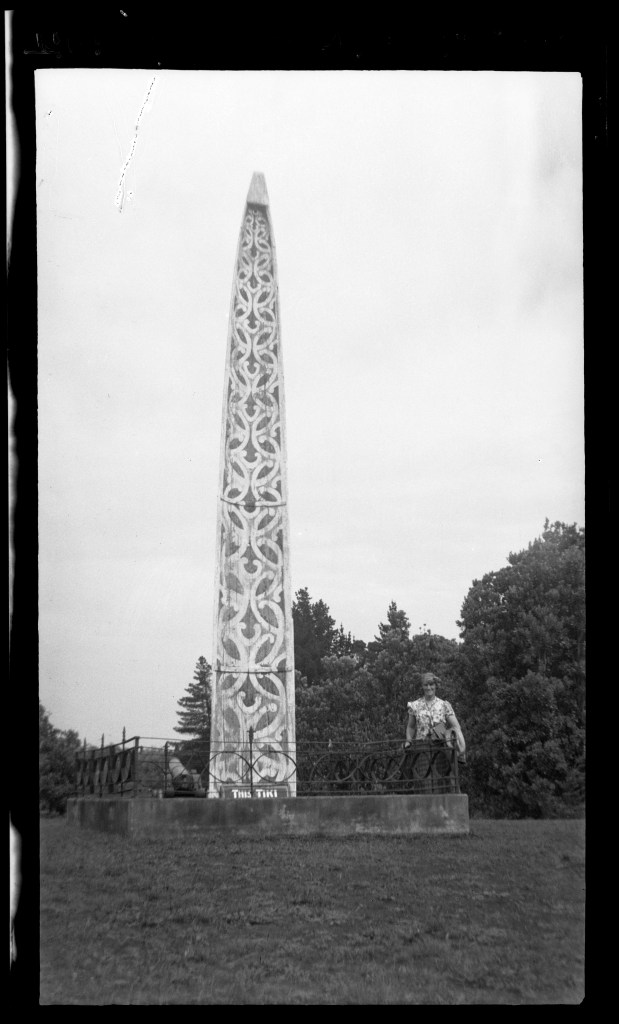
A ‘tiki’ in the form of a Maori canoe, which took part in a fight at Kapiti, has been acquired by the [St John’s Hill Beautifying] [S]ociety and is being carved under the supervision of Mrs. Gregor McGregor, and is being erected on ‘Pura’ Point, overlooking the far end of Virginia Lake.
Wanganui Chronicle, 28 September 1917
However, when Pura died on 4 March 1920, this project was evidently uncompleted. In December of that year, the President of the St John’s Hill Beautifying Society feared it would not be possible to complete the carving of the waka, due to Pura’s death. A year and a half later, however, work on the tiki had resumed, and it was now being described as a memorial to Pura:
The canoe, from which the memorial is being prepared, is a very old one, but its timber is in a splendid state of preservation. It has been thoroughly overhauled, cleaned, and painted in a typical Maori manner, and will make an appropriate memorial.
Wanganui Chronicle, 23 May 1922
By January 1923, the waka had been installed at the far end of Virginia Lake/Rotokawau, on the former site of Toronui pā, as a memorial to Pura. It was described as ‘a very old and fine Maori canoe erected on its end, and painted in true Maori style, and is visible from all parts of the lake’. The memorial was surrounded by an iron fence, and there was a plaque at the base stating that the tiki had been erected to the memory of Pura McGregor.
Canoe tiki memorial to Te Pura Manihera (Mrs Gregor McGregor) near Virginia Lake, Wanganui (3), 17 March 1941, by Leslie Adkin. Gift of G. L. Adkin family estate, 1964. Museum of New Zealand Te Papa Tongarewa (A.006786)
The description of the memorial as a tiki may seem unusual, as that term is more commonly used today for an abstract human figure worn as a neck ornament. However, another meaning of ‘tiki’ (according to Williams’ Dictionary of the Māori Language) is ‘a post to mark a place which was tapu [under a spiritual restriction]’. The use of the word tiki to describe the memorial to Pura probably refers to the Māori practice of using upturned waka as grave markers for people of high rank. Waka whakamaumahara (memorial canoes) has been recorded by Pākehā observers since the 1830s. When rangatira died, their waka might be cut in half so that the prow could be carved and painted, and erected as a memorial. The rangatira might be buried at the site where the waka whakamaumahara is erected, but more likely their remains would lie elsewhere and the waka would function as a memorial.
Māori tombs depicted by George French Angas, from his visit to New Zealand in 1844 (lithograph by J.W. Giles). The memorials on the left and right sides in the middle row are waka whakamaumahara from the Upper South Island. Giles, John West, 1801-1870. Angas, George French, 1822-1886 :Native tombs / George French Angas [delt]; J. W. Giles [lith]. Plate 50. 1847.. Angas, George French 1822-1886 :The New Zealanders Illustrated. London, Thomas McLean, 1847.. Ref: PUBL-0014-50. Alexander Turnbull Library, Wellington, New Zealand. /records/22745460
The waka whakamaumara for Pura McGregor was a memorial only: she is buried, together with Gregor, in Heads Road Cemetery, Whanganui. Unlike European memorials of stone or metal, waka whakamaumhara were not made of durable materials, and were perhaps not intended to survive indefinitely. In the case of Pura’s memorial, it become rotten and was removed in 1988.
In recent years, the Virginia Lake Trust decided to replace the memorial and, with support from the McGregor whānau, commissioned a new steel memorial by local artist Cecilia Kumeroa. The new memorial was opened in September 2020. It preserves the form of the waka whakamaumahara in a more durable material, and repeats the painted patterns from the original memorial as a cut-out design. It’s a striking and modern memorial which very effectively links past and present to commemorate Pura’s achievements in both the Māori and Pākehā worlds.
There are two things about the original memorial, and its modern replacement, that I find particularly interesting. First, it’s a rare example of a memorial to a Māori woman (indeed, memorials to women of any ethnicity are notoriously rare not only in Aotearoa but around the world). Second, it’s an early example of a memorial in a public place that draws on Māori iconography and commemorative practices, rather than copying the commemorative forms of Europe. The move away from European commemorative traditions is becoming more common now, with increasing use of pou (commemorative poles) and innovative memorials like thosedesigned by Tūranga (Gisborne) artist Nick Tupara. By erecting the waka whakamaumahara to Pura Te Mānihera Makarika a century ago, Whanganui took a forward-looking step that the rest of Aotearoa is only just catching up with.
References
Miriam McGregor, ‘Pura McGregor’, in her Petticoat Pioneers: North Island Women of the Colonial Era, vol. 2, A.H. & A.W. Reed, 1975, ch. 19.
Michelle Horwood and Che Wilson, Te Ara Tapu: Sacred Journeys: Whanganui Regional Museum Taonga Māori Collection, Auckland, Random House/Whanganui Regional Museum, 2008.
Stephen Deed, Unearthly Landscapes: New Zealand’s Early Cemeteries, Churchyards and Urupā, Dunedin, Otago University Press, 2015, ch 2.
Ewan Morris, ‘Māori Monument or Pākehā Propaganda? The Memorial to Keepa Te Rangihiwinui, Whanganui’, in Annabel Cooper, Lachy Paterson and Angela Wanhalla (eds), The Lives of Colonial Objects, Dunedin, Otago University Press, 2015, pp. 230-235.
Ewan Morris, ‘“Kia Mau ai te Ora, te Pono me te Aroha ki te Ao Katoa”: The Māori First World War Memorial at Whanganui’, Turnbull Library Record, vol. 46, 2014, pp. 62-79.
In a previous post, I wrote about the fierce debate that took place in the 1980s about the name of Taranaki Maunga (known at the time to most Pākehā as Mount Egmont), and about my struggle to turn my research about this debate into a published article. Now, courtesy of giving myself a push by presenting a paper at the New Zealand Historical Association (NZHA) conference last year, I’ve finally published my article on the debate. It’s been published in a special issue of the Public History Review journal on the theme of ‘Public History in Aotearoa New Zealand’, based on a selection of papers from the 2021 NZHA conference. The articles in this issue of the journal will be good reading for anyone with an interest in history and memory in Aotearoa.
My article (titled ‘”Egmont, Who Was He?’ The Debate Over Restoration of the Name of Taranaki Maunga”) looks at the background to this major place name debate, the themes in the debate, and the reasons for the intensity of the debate. It also draws some connections to the new Aotearoa New Zealand histories curriculum, which features themes relating to place names.
Currently, the official name of the maunga is still ‘Mount Taranaki or Mount Egmont’, the compromise solution which emerged from the 1980s debate. However, the name is due to be finally changed to recognise the Māori name Taranaki alone, as part of the Taranaki Maunga Treaty of Waitangi Settlement, which is expected to be completed soon. I hope my article can provide some useful context when this change finally takes place.
Nancy makes the acquaintance of Guy Fawkes, 5 November 1919, Hastings, by Leslie Adkin. Gift of G. L. Adkin family estate, 1964. Te Papa (A.006644)
Yesterday was Guy Fawkes Day, and it is almost becoming a tradition for New Zealand media to celebrate the occasion by running pieces on two topical issues: Should the sale of fireworks be banned? And should we be commemorating the resistance of the Taranaki Māori community of Parihaka (which was invaded by government forces on 5 November 1881) instead of the foiling of the 1605 plot by Guy Fawkes and other English Catholics to blow up the English Parliament and install a Catholic monarch? For the record, my answer to both questions is ‘yes’, but the focus of this post is a bit different.
As the historian David Cressy notes, after the Gunpowder Plot was discovered and the conspirators had been captured, tortured and executed, the English Parliament passed a law for an annual act of public thanksgiving on 5 November to ensure the nation’s deliverance from the plot was held in ‘perpetual remembrance’. Cressy calls this ‘one of the earliest examples of legislated memory’, which ‘provided a model for subsequent acts of commemoration’. The law mandating the day of commemoration was not repealed until 1859, and the imperative to remember was also captured in the popular rhyme:
Please to remember the Fifth of November
Gunpowder Treason and Plot
We know no reason why Gunpowder Treason
Should ever be forgot.
Over time, Guy Fawkes Night became a popular festivity marked by socially licensed misrule, featuring bonfires, the burning of effigies of Fawkes and others, and, eventually, fireworks. In the late nineteenth century, authorities had some success in bringing the festivities under control by providing organised entertainment, and the focus changed again during the twentieth century with the commercial availability of fireworks.
As Guy Fawkes Night became a popular festival, it also came to focus less on the historical details of the Gunpowder Plot and more on current events and hate-figures of the times in which the festivities took place. David Cressy writes that:
Foreign and imperial affairs brought new figures into the Guy Fawkes pageant. Effigies of the 1870s included Pope Leo XIII, the Tsar of Russia, the Sultan of Turkey, the Amir of Afghanistan, Araby Pasha and the king of the Zulus. The Irish leader Parnell appeared on the bonfires in 1879…. Historical memory gave way to current affairs.
David Cressy, ‘Four Hundred Years of Festivities’, in Brenda Buchanan et al, Gunpowder Plots: A Celebration of 400 Years of Bonfire Night, London, Allen Lane, 2005
In New Zealand, too, Guy Fawkes effigies of the German Kaiser were burned during the First World War, as were effigies of Hitler during the Second World War. What may be surprising, however, is that in 1881 some Pākehā New Zealanders drew a connection between Guy Fawkes and the Parihaka leader Te Whiti-o-Rongomai.
Today, when people argue that we should commemorate Parihaka’s campaign of non-violent resistance rather than the Gunpowder Plot, the underlying assumption is that the two events could not be more different in their nature and their significance to Aotearoa New Zealand. The Taranaki Daily News, for example, editorialised in 2012:
Fawkes was a religious zealot and would-be terrorist who almost succeeded in killing and maiming thousands of people. On the other hand, Parihaka played host to the dramatic conclusion of a now-celebrated campaign of peaceful activism against land theft in a manner that propelled other activists in other countries to iconic status worldwide.
Taranaki Daily News, 26 June 2012, p 8
At the time of the invasion of Parihaka, however, many Pākehā had convinced themselves (or been convinced by what we might now call disinformation) that Te Whiti, Tohu and their followers were themselves dangerous plotters who posed a genuine threat to public order and safety. Astonishing though it may seem today, it was not outlandish in 1881 for Pākehā to speak of Guy Fawkes and Te Whiti in the same breath. The fact that the Gunpowder Plot was a Catholic conspiracy may be relevant here. This was a time when sectarianism was still a powerful force in New Zealand society, and many Protestants viewed Catholics as superstitious, credulous and in thrall to their religious leaders – the same characteristics Pākehā attributed to the people of Parihaka. But above all, Parihaka had been the subject of so much rumour- and fear-mongering that it could seem plausible to depict Te Whiti as New Zealand’s Guy Fawkes.
In the leadup to the invasion, for example, rumours spread that the people of Parihaka had positioned dynamite in the village so that ‘the Divine interpretation promised by Te Whiti on the 5th November will consist in blowing up the New Zealand forces as Guy Fawkes proposed to do to the House of Commons on that day two or three centuries ago’. Even the newspapers at the time conceded that this rumour was unfounded and absurd. The Poverty Bay Herald, however, published two poems which mocked Te Whiti, linked him to Guy Fawkes, and celebrated the suppression of the Parihaka resistance:
Remember, remember, this Fifth of November,
Native Policy, Armed Force, and the lot.
There is reason to doubt, that they’ll suffer a rout,
If they give way to Te Whiti one jot;
Then let it appear,
To that savage, most clear,
That his day dreams have come to an end —
He is doomed to the Pakeha to bend,
And so say all of us.
‘Monteagle’, ‘Ye Modern Guy Fawkes Plot’, Poverty Bay Herald, 5 November 1881, p 2
Ah! Long shall we New Zealanders a well-known date remember —
The which Guy Fawkes commemorates, the fifth day of November
When Bryce, by British bayonets backed, read out the Act called Riot,
And bold Te Whiti — why he “caved in,” like a lamb so quiet.
‘J.J.P.’, ‘The N.Z. Guy Fawkes’, Poverty Bay Herald, 7 November 1881, p 2
Of course, Te Whiti had not ‘caved in’ but rather been arrested, and would be held in detention by the government, not being allowed to return to Parihaka until 1883. The invasion was a source of huge and ongoing trauma for the people of Parihaka and for Taranaki Māori more widely. For many Pākehā at the time, however, it was cause for celebration. The New Zealand Herald reported:
The Fifth of November, the anniversary of the Gunpowder Plot, has been celebrated this year with unusual rigour, principally it is believed, as enabling the youngsters to hit two birds with the one stone — namely, commemorating the crime of Guy Fawkes, and the capture of Te Whiti. Crackers and squibs were being exploded in the streets to a late hour on Saturday, while bonfires were blazing in every suburb, and on the top of nearly all the hills surrounding Auckland.
New Zealand Herald, 8 November 1881, p 4
Pākehā ‘youngsters’ of today may still enjoy fireworks, but we can hope that the new New Zealand histories curriculum will mean they will have a much better understanding of the events at Parihaka than their counterparts of 140 years ago.




 PastWord